
Fifth information notice: Clarifications from the Consorcio de Compensación de Seguros (CCS) on the most frequently received questions regarding the volcanic eruption on the island of La Palma
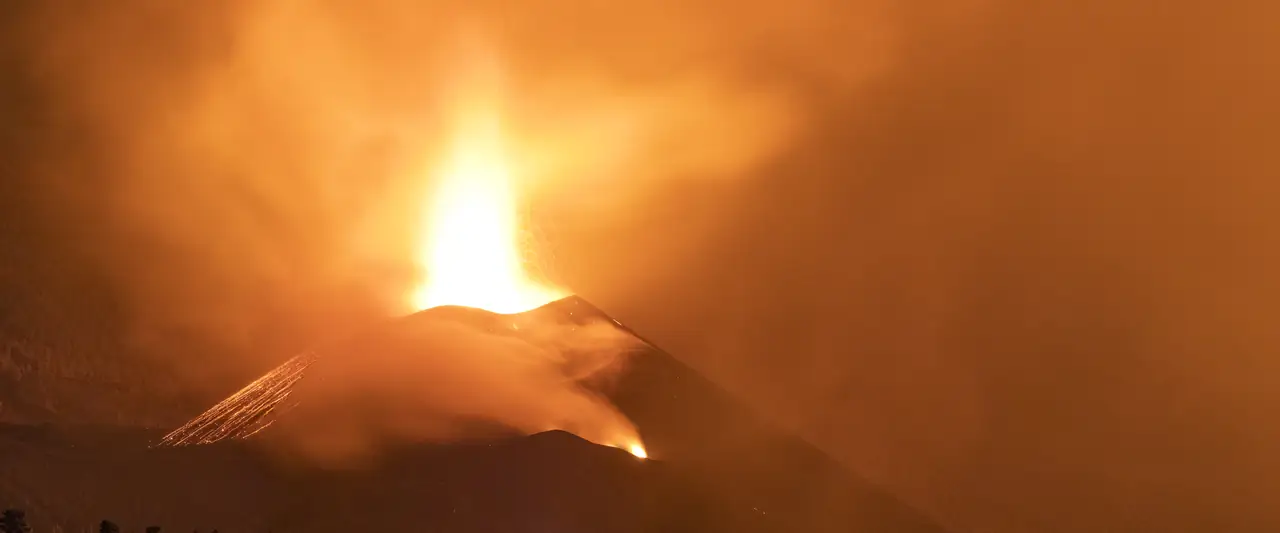
Cumbre Vieja volcano, La Palma
In this fifth information notice on the CCS's activity in connection with the volcanic eruption on the island of La Palma, this public body sets out clarifications to the questions it has received most frequently so far.
FIFTH INFORMATION NOTICE: CLARIFICATIONS FROM THE CONSORCIO DE COMPENSACIÓN DE SEGUROS (CCS) ON THE MOST FREQUENTLY RECEIVED QUESTIONS REGARDING THE VOLCANIC ERUPTION ON THE ISLAND OF LA PALMA
- How much could the La Palma volcanic eruption cost in compensation?
Unlike other cases, such as floods or earthquakes, where the CCS has provisional estimates within 48 or 72 hours through urgent expert surveys of the affected areas and property, this is an exceptional event. On the one hand, the phenomenon has continued and will continue to evolve; on the other, the worst-affected areas are not accessible; and, finally, we do not know the real level of insurance cover, unlike in other parts of Spain where we are used to dealing with floods and coastal storms, for example. Hence the difficulty in producing stable, reliable estimates.
Nevertheless, the CCS is working to have estimates available as soon as circumstances allow.
Regardless of the above, the most important thing is that affected policyholders should know that the CCS will honour all its commitments under the insurance contracts, whatever the amount of the compensable damage may be.
2. How long will the CCS take to pay those affected?
Equally important, and reassuring, is that affected policyholders should know that the CCS, under its standard procedures, always tries to make the first compensation payments within 10 days of the extraordinary risk occurring (flood, earthquake, etc.).
In this case, within 10 days of the eruption starting, the CCS had paid out €625,000, covering some destroyed homes.
Finally, and from this point on, based on our experience of complex claims involving thousands or tens of thousands of affected policyholders, the CCS deals with all compensation claims received within 4 months.
3. Are public aid payments compatible with CCS compensation for the volcanic eruption?
Up to what point? Does CCS cover exclude the official declaration of a "disaster zone"?
Public aid is indeed compatible with insurance compensation, provided that the aid amount plus the insurance compensation does not exceed the value of the damage caused, since exceeding it would result in unjust enrichment for the person affected.
This is why the law expressly provides for the exchange of information between the CCS and the government bodies managing the aid, to avoid duplicate payments or aid amounts that exceed that limit.
Since public aid and insurance compensation are compatible, it is necessary to firmly dispel the false belief that a government declaration of an "area seriously affected by a civil protection emergency" (commonly known as a "disaster zone" declaration) halts insurance action. Insurance action is in no way cancelled or suspended, whether private insurance (e.g. in the case of rain) or the public CCS (e.g. in the case of flood, earthquake or, as here, volcanic eruption).
In short, it is very important to make clear that the approval of public aid or grants does not suspend insurance action in any way.
4. What happens to those without home, shop or business insurance?
Uninsured people or property cannot receive compensation from the CCS, since it is a public insurance institution.
Those who are not insured will be able to access whatever public aid is approved, within the limits and requirements set for its award.
The conclusion is clear: insurance, whether private or through the CCS, is the fast and reliable mechanism for compensating damage caused by natural events. Compensation can be requested immediately by the affected person, with no need to wait for any official "disaster zone" declaration or similar; the amount of compensation is determined by the terms and sums insured set out in the affected person's insurance contract; and the insurance mechanism acts quickly: within 10 days of the volcanic eruption, the CCS had begun paying the first amounts of compensation.
5. What happens if I am behind on my insurance payments?
In the case of a new policy, to be entitled to compensation for the volcanic eruption you must first have paid the premium and the CCS surcharge (paid together on the same bill).
In the case of renewing an existing policy, the law allows a one-month period, known as the "grace month", for payment. If the claim occurs within that month, the CCS will pay the corresponding compensation for damage caused by the volcanic eruption; but if that extra month has already passed, the policy is suspended until the premium is paid, and the CCS will not pay for damage caused by the volcanic eruption while the insurance contract remains suspended.
6. How far does CCS cover extend? Is there a maximum amount?
The CCS covers and assesses damage under the terms set out in the clauses of the insurance contract taken out by the policyholder. In essence, the public CCS steps into the shoes of the private insurer when the damage is caused by one of the "extraordinary risks", such as flood, earthquake or volcanic eruption. The only limit is the one set in the policy held by the affected person.
However, in the case of shops, industrial premises and civil works, there is a legal excess of 7% of the compensable damage, which is borne by the policyholder.
This means that in these cases, the CCS covers 93% of all compensable damage, whatever the amount, so that for every €100 of compensable damage, the CCS pays €93.
7. Are all motor vehicles damaged by the volcanic eruption entitled to CCS compensation? Even those with third-party-only cover?
In the case of motor vehicles (cars, lorries, buses, commercial vehicles, motorcycles, mopeds, etc.), damage will be compensated both where the vehicle had some form of own-damage cover (for example, glass breakage, theft, or so-called comprehensive cover with or without excess), and where it only had a policy covering third-party liability (policies usually known as "compulsory insurance" or "third-party cover").
8. Can property and personal belongings near the La Palma eruption still be insured, more than 7 days after the eruptions began?
Under the Extraordinary Risks Insurance Regulations, there is a waiting period of 7 days from the date of issue or the effective date, if later, of the insurance policy until the
occurrence of the claim. The date of the claim will be the point at which the damage to the relevant insured property actually occurs. If that moment cannot be established, the known and documented date of 19 September may ultimately be applied, being the date the volcanic eruption began and, therefore, when the phenomenon classifiable as an "extraordinary risk" as a whole started.
For property already insured, the 7-day waiting period will also apply to any endorsements (for example, changes to sums insured) whose issue date or effective date, if later, does not precede the date of the claim by 7 calendar days. In these cases, the sums insured to be considered would be those in force before the endorsement.
Finally, nothing prevents, naturally, insuring property and people before or after the 7-day period. A separate question is determining, where insurance was taken out at the time of the 19 September eruption or afterwards and the insured property suffered damage from the volcanic phenomenon, exactly when the damage actually occurred and whether the insurance is or is not within its waiting period, given the timing of the insurance payment and of the damage.
9. What are the requirements for determining a "disaster zone"?
As already noted, the declaration is not called a "disaster zone", but a "declaration of an area seriously affected by a civil protection emergency", under the terms of the current Law 17/2015 on the National Civil Protection System (published in the BOE, Spain's official gazette, on 10 July 2015). The CCS plays no part in that declaration, which is made by Agreement of the Council of Ministers, and has nothing to do with it. Likewise, it must be stressed that the public aid or grants that may follow from that government declaration should not be confused with the compensation that the CCS pays under insurance contracts.
Insurers and insurance intermediaries operating on the island of La Palma should keep a close eye on the Agreements approving aid, so as to be able to properly advise
policyholders on the distinction between the aid and CCS compensation, and on how to apply for each. At the same time, it is very important that they help to dispel the false, but widespread, belief that the declaration and approval of aid switch off the insurance mechanism — in this case via the CCS — which is not the case, as already explained in point 3 above.
Madrid, 4 October 2021
Do you have a specific question?
Write to us and we'll answer without the jargon.