
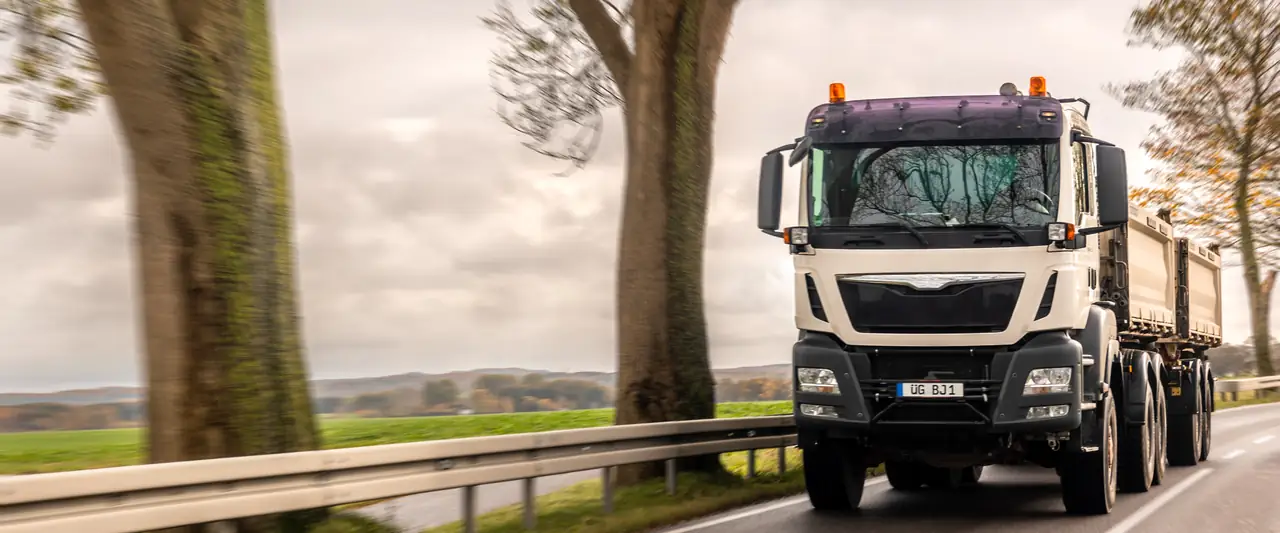
Lorry and industrial vehicle insurance: what to cover beyond the compulsory minimum
Commercial and agricultural vehicles
Compulsory insurance on a lorry meets the damage you cause to others while driving. Nothing more. It doesn't pay for repairs to your own vehicle, it doesn't cover the load, it doesn't compensate you for the days the lorry spends in the garage and, depending on how it's arranged, it may not extend to the trailer. If the vehicle is your working tool, almost everything you actually worry about after an accident falls outside that minimum. In this article we go through, point by point, what's worth considering beyond the compulsory cover and how to decide what's worth taking out.
What compulsory insurance does (and doesn't do)
Every motor vehicle needs compulsory insurance to be driven, whether it's a car, a delivery van or a tractor unit. That compulsory third-party liability covers the personal injury and material damage you cause to third parties with the vehicle, within the limits set by law.
What's left out is precisely what affects your business: the lorry itself, what you're carrying, the time it's off the road, injury to the driver when the fault is their own, and the cost of defending yourself if the matter ends up in proceedings. All of that is taken out separately, either as voluntary cover on the same policy or as separate insurance.
The points worth considering, one by one
1. Voluntary third-party liability
A heavy vehicle can cause far greater damage than a car: several vehicles involved, a bus shelter, the wall of a warehouse, street furniture. Voluntary third-party liability raises the limits above the compulsory minimum. Ask what limit is being proposed, whether it applies per claim or per year, and whether it covers damage to third parties' loads or not.
2. Own damage
This is the cover that pays for repairing the lorry when you cause the accident yourself, or when there's no third party to claim against: a rollover on a bend, a knock while manoeuvring at a loading bay, an engine fire. It's usually taken out with an excess, and the size of that excess changes the price considerably. Before choosing, think about how much you could absorb without it throwing off your month. And ask how the vehicle is valued in the event of a total loss: the market value of an older lorry is not the same as what it would cost you to replace it.
3. Theft, fire and glass
Many vehicle policies offer these covers separately or as a package. On an industrial vehicle, theft can affect the lorry itself, its equipment or specific items such as the fuel tank or tools. Check what counts as part of the vehicle and what doesn't, and whether there are security conditions, such as keeping it locked or in a guarded compound overnight.
4. The goods
This is one of the most common misunderstandings: assuming that lorry insurance covers the load. As a rule, the vehicle policy focuses on the vehicle and on damage to third parties. For the goods, there's goods-in-transit insurance, which can cover the goods carried and the vehicles that carry them, whether you're carrying your own goods or someone else's, for hire or reward.
If you carry goods for third parties, it's also worth reviewing how far your liability as a carrier extends towards the client, and how much of that risk you want to pass on to an insurer. This is an analysis worth doing calmly, with your clients' contracts in front of you.
5. Trailer and semi-trailer
Light trailers are usually covered by the policy of the vehicle towing them; above a certain weight they need their own policy. With a tractor unit that hitches up different semi-trailers, the key question is who insures each semi-trailer and with what cover. What can't happen is that nobody's sure on the day of the accident. Check the registration document of each trailer and note which policy it belongs to.
6. Vehicle off the road
For a self-employed haulier or a small transport business, every day without a lorry is a day without income, while the loan instalment, the insurance and wages keep running. Some policies, such as vehicle fleet insurance, include compensation for the vehicle being off the road. If that matters to you, ask from which day it starts being paid, what daily amount it recognises, for how many days at most, and in which cases it applies: only after an accident, or also after a breakdown or theft.
7. Roadside assistance for heavy vehicles
Roadside assistance includes towing and help in the event of a breakdown or accident, but not every assistance service is set up for a heavy-tonnage vehicle. A tow truck for cars won't do. Check that the service is set up for your vehicle's weight and dimensions, from what distance from your home it operates, and whether it also covers moving the trailer or semi-trailer. You'll find more detail on this cover in what travel assistance is and what it covers.
8. The driver
If the driver is at fault for the accident, third-party liability doesn't compensate them. That's what driver accident cover is for, which usually includes compensation for death or disability and medical assistance arising from the accident, depending on what's taken out. If the drivers are employees, their protection as staff runs through other routes: the collectively agreed accident insurance and the business's employers' liability.
9. Legal expenses cover and loss of licence
An accident involving a heavy vehicle can end in lengthy claims or in proceedings. Legal expenses cover takes care of defending you and of claiming your own damages when someone else is at fault. Loss-of-licence cover, which some policies include, compensates a professional driver if they temporarily lose their licence. For someone whose livelihood depends on driving, that's no small detail.
Three cases to make it clear
The rollover on a roundabout. A delivery lorry rolls over taking a roundabout with a badly loaded cargo. No third party is damaged. With only the compulsory cover, repairing the lorry, recovering it and the value of the load are all at your own expense. With own damage cover, heavy-vehicle assistance and goods-in-transit insurance, each part has something to answer for it.
The tractor unit with an uninsured semi-trailer. A business hitches up a client's semi-trailer for a one-off job. There's a collision and the semi-trailer damages another vehicle. The loss adjuster's first question will be which policy covers that semi-trailer. If nobody had checked, the problem is no longer the collision, but the lack of cover.
Three weeks in the garage. A refrigerated van has an accident and needs a part that takes time to arrive. The third party's insurance repairs the vehicle, but the business loses three weeks of routes. Only compensation for the vehicle being off the road, if it had been taken out, makes up for part of that loss.
Common mistakes
- Insuring the industrial vehicle as if it were a car, without saying what it's used for or what it carries.
- Assuming the goods are automatically included in the lorry's policy.
- Not checking which policy each trailer or semi-trailer belongs to.
- Choosing too high an excess on own damage to save money, then finding out later it can't be afforded.
- Forgetting that a driver at fault isn't covered by third-party liability.
- Not telling the insurer about changes in use, route or type of load, which can amount to an increase in risk.
- Letting the ITV lapse: a valid inspection is a condition for driving, and insurers usually require it.
Checklist before you sign
- Voluntary third-party liability limit, and whether it applies per claim or per year.
- Own damage: what's covered, with what excess, and how the vehicle is valued in a total loss.
- Theft, fire and glass: which items are included and what security conditions apply.
- Goods: whether the vehicle policy says anything, and if not, what goods-in-transit cover you need.
- Trailers: registration document and the policy that applies to each one.
- Off the road: start day, daily amount, maximum duration and applicable cases.
- Roadside assistance: whether it's set up for the vehicle's weight and dimensions.
- Driver: driver accident cover and, if you have staff, the collectively agreed policies.
- Legal expenses cover and loss of licence.
- If you work between islands, how the policy treats ferry crossings and the load while it's being loaded.
Not all of these covers are essential for everyone. A self-employed driver with a delivery van and a business with five tractor units need different things. The list is there so the decision is yours, not an oversight.
How we help at Retuerto y Asociados
As brokers, we don't work for one insurer: we compare the market and put in writing what each option covers and with what limits. We start with the vehicle's registration document and its actual use, and tell you what belongs on an individual policy, what on a fleet policy and what on a goods-in-transit policy. You'll find the product summary on the industrial and agricultural vehicles page, and if you tell us about your situation we'll prepare a free quote with the comparison. If you'd rather talk it through first, write to us via contact.
Can we help with a specific question?
Write to us and we'll answer in plain language.