
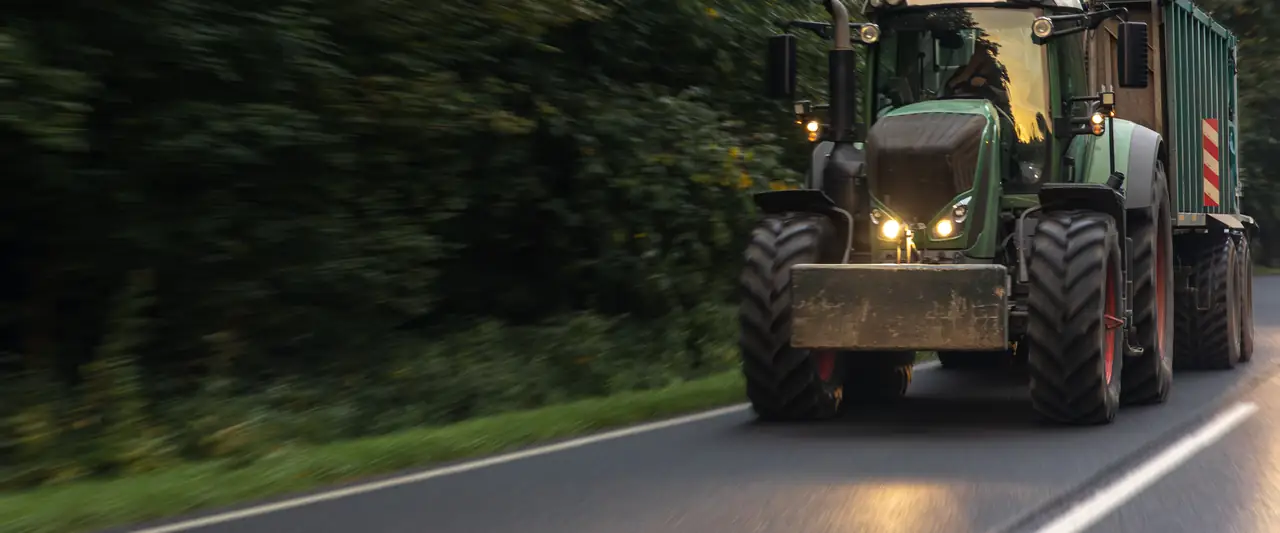
Tractors on public roads: insurance, ITV and third-party liability
Commercial and agricultural vehicles
To take a tractor onto the road, you need two things in order: compulsory insurance and a valid ITV (the Spanish MOT-equivalent inspection). A tractor is a motor vehicle and, in that respect, is no different from a car. But there's a third piece that many farmers discover too late: compulsory insurance covers what happens while driving, not what happens while working. If an implement damages the neighbour's field, or a spray treatment drifts onto the plot next door, that's a different cover: liability for agricultural work. Here we explain all three, with examples, so you know what to check in your policy.
Compulsory insurance: the condition for driving
A tractor leaving a field onto a public track, a road or a village street is driving, and for that it needs compulsory insurance just like any other motor vehicle. That third-party liability for driving meets the personal injury and material damage you cause to third parties with the vehicle on the public road, on the terms set by law.
It makes no difference if the tractor only comes out for a few minutes a year to move between plots, or if it's old and hardly used: if it's on the public road, it has to be insured. Driving uninsured exposes you to a fine and, above all, to paying out of your own pocket for any damage you cause.
A tractor for private use is not the same as one for professional use, either. Tractor and farm machinery policies are tailored to each machine and its use, and the price depends on how it's used, the cover taken out, its weight, its year of registration and the model. That's why two similar tractors can carry very different premiums.
The ITV: a prerequisite, not an optional formality
As with any motor vehicle, a valid technical inspection is a condition for driving legally, and insurers require it to issue or renew a policy. What's more, each depends on the other: the insurance is needed to pass the inspection, and the inspection is needed to issue the insurance. If your ITV has expired, sort that out first and arrange the insurance straight after.
A few practical tips to avoid surprises:
- Note the ITV expiry date for each tractor and each trailer that needs one, in the same place you keep track of your insurance renewal.
- Before the inspection, check the lights, signage and safety features, which are the points most commonly checked on the road.
- If you've made modifications or permanently changed implements, check whether they affect the registration document before you go.
Driving isn't working: liability for agricultural work
This is the part most often overlooked, and where most policies taken out without advice fall short. Compulsory third-party liability covers what happens while driving; liability for agricultural work covers what happens while working. They are two different things, and the most likely damage on a farm happens while working.
Think of situations like these:
- An implement that, while turning at the headland, knocks down the neighbouring field's stone wall.
- A crop-spraying treatment that drifts in the wind onto another plot and ruins another farmer's harvest.
- A machine that, while preparing the ground, breaks a buried water pipe.
- A stone thrown up by the brush cutter that damages a car parked by the track.
In none of these cases was the tractor driving: it was working. If your policy doesn't include liability for agricultural work, or includes it with a very low limit, you pay for that damage yourself. That's why, when we review a farm policy, the first thing we look at is whether it's included, and with what limit.
If you do work on other people's land, for example ploughing or harvesting for other farmers, there's a further point: the cover needs to expressly include activity carried out away from your own property. Don't take it for granted.
The trailer and the implements
Light trailers are usually covered by the policy of the vehicle towing them; above a certain weight they need their own policy. The way to find out is to check the trailer's registration document. Implements attached to the main machine can be included in the tractor's policy, and depending on the option, theft cover can also extend to attached implements and equipment.
A trailer loaded with fruit or manure that comes loose on a slope, or a badly secured load that falls onto the road, are real situations. Check that the trailer is identified on some policy, and that the load is properly secured and marked.
Whoever drives the tractor
The agricultural sector records a high number of serious accidents involving machinery every year, and rollovers are among the most feared. The vehicle's insurance covers the driver on the terms taken out: driver accident cover usually includes compensation for death or disability and medical assistance arising from the accident.
If the farm employs staff, their protection runs through other routes: the collectively agreed accident insurance and employers' liability, which forms part of the business's third-party liability cover. Also make sure that whoever drives each machine holds the licence that applies to that vehicle.
Practical cases
Moving between fields by road. A farmer from the mid-altitude areas takes the tractor along a narrow road to move from one plot to another. A car coming up behind tries to overtake on a bend and clips the trailer. This is a driving incident: compulsory third-party liability comes into play, and if the other driver is at fault, legal expenses cover helps claim for your own damage.
Working on someone else's land. A self-employed contractor providing ploughing services to other farmers damages a buried irrigation pipe with the plough on the field they're working. This is damage caused while working, and on land that isn't theirs. Only liability for agricultural work answers for it, and only if it covers activity away from their own property.
An old tractor without an ITV. An inherited tractor hasn't been through inspection for years and is only used within the farm. The day it needs to go out on the track to be taken to the workshop, it can't legally be driven. The solution is to transport it on a low-loader, or to sort out the ITV and the insurance before moving it.
Common mistakes
- Thinking that a tractor that hardly ever leaves the farm doesn't need insurance.
- Taking out only the compulsory cover and believing it covers damage caused during fieldwork.
- Not declaring that you work on other people's land.
- Forgetting to insure a trailer that, because of its weight, needs its own policy.
- Letting the ITV lapse and only discovering it when the insurance comes up for renewal.
- Confusing tractor insurance with agricultural insurance: the latter protects crops and the farm against risks such as hail, frost or drought, not the machine.
Quick checklist before heading onto the road
- Compulsory insurance in force and the premium up to date.
- A valid ITV for the tractor and, where applicable, the trailer.
- Liability for agricultural work taken out, with an adequate limit.
- Activity on other people's land included, if you carry it out.
- Trailers and implements identified on the policy they belong to.
- Driver accident cover and, if you have staff, collectively agreed policies.
- Lights and signage checked, and the load properly secured.
If you have several vehicles on the farm besides the tractor, it's worth organising them together. We cover this in mixed fleets: vans, lorries and machinery.
How we help at Retuerto y Asociados
We review your current policy or prepare a new one for you, starting with what makes the biggest difference between them: whether it includes liability for agricultural work, with what limit, and whether it covers work away from your own land. If the business also has lorries, vans or trailers besides the tractor, we look at everything together on the industrial and agricultural vehicles page. Request your free quote or tell us about your situation via contact.
Can we help with a specific question?
Write to us and we'll answer in plain language.