
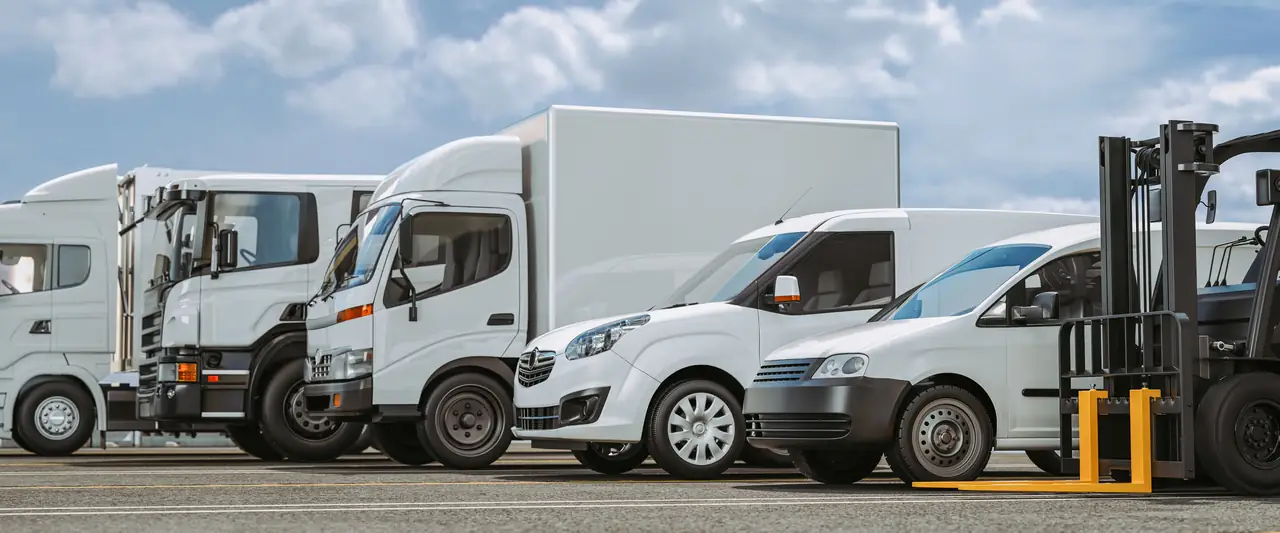
Mixed fleets: how to organise the policies for vans, lorries and machinery
Commercial and agricultural vehicles
A business that has grown over time often ends up with a fleet that nobody actually designed: three vans insured with different insurers, a lorry bought second-hand with whatever policy the dealer offered, a tractor or a machine with its own separate insurance, and a couple of trailers that nobody remembers where they're insured. Sorting it out isn't about putting everything on a single policy, it's about making sure each vehicle sits where it belongs, with no gaps and nothing paid for twice. In this article we set out a five-step method for getting there.
Step 1: take a real inventory
Before talking about policies, you need a complete list of what you have. For each vehicle or machine, note down:
- Type: car, van, lorry, tractor unit, trailer or semi-trailer, tractor, self-propelled machinery.
- Registration number, registration date and details from the registration document, especially the weight.
- Use: urban delivery, inter-town routes, building work, fieldwork, business travel.
- Who drives it: a fixed driver, several employees, or anyone on staff.
- What load it carries, if any, and whether it's your own or a client's.
- Current policy: insurer, number, cover, excess, renewal date and price.
- ITV expiry date.
This inventory often uncovers surprises: a trailer nobody has insured, a van that's been sold but is still on a policy, two identical vehicles with very different cover, or a renewal date that falls right in your busiest season.
Step 2: group by type of risk, not by make or age
Not every vehicle in a business fits the same type of policy. This table sums up where each one usually belongs and what's worth checking:
| Vehicle or risk | Where it usually fits | What to check |
|---|---|---|
| Cars, motorbikes and vans | Fleet policy, if the minimum number of vehicles is reached | Minimum number required by the insurer, cover per vehicle, management of additions and removals |
| Lorries, tractor units and heavy vans | Fleet, if the insurer accepts them, or an individual industrial vehicle policy | Third-party liability limits, own damage, downtime, assistance for heavy vehicles |
| Trailers and semi-trailers | The towing vehicle's policy if light; their own policy above a certain weight | Each one's registration document and which policy it belongs to |
| Tractors and farm machinery | Tractor and farm machinery insurance | Liability for agricultural work, work on other people's land, ITV |
| Goods carried | Goods-in-transit insurance | Own account or for hire, value of the load, road, sea or air journeys |
| Fixed machinery on site | Industrial multi-risk insurance | Premises, machinery and stock, and loss of profits |
The idea is that each risk has a policy that covers it properly, and that policies don't overlap. The lorry and the load it carries are two different risks; the tractor driving and the tractor working, too.
Step 3: decide what goes on the fleet policy
Fleet insurance allows you to include all of the business's vehicles on a single policy, with unified terms and renewal. Each vehicle must carry at least third-party liability cover, and the minimum number of vehicles required to take out a fleet is usually around ten, though it varies by insurer.
Its usual covers include compulsory third-party liability for each vehicle, own damage, loss of licence, a replacement vehicle, damage from hunting, compensation for a vehicle being off the road, and unified management of additions and removals. That last point is the one that makes the biggest difference day to day: you add the new van and remove the one that's been sold without opening a fresh contract each time.
What's worth checking on a mixed fleet is whether the insurer accepts heavy vehicles or tractor units on the same policy, and whether cover can vary by vehicle. It makes no sense to pay for own damage on a fifteen-year-old van while leaving a newly bought lorry without it. A good fleet policy lets you adjust each vehicle without losing the unified management.
If you don't reach the minimum, or if your vehicles are very different from each other, that's fine: you can have well-coordinated individual policies and still get much of the benefit of being organised.
Step 4: take out of the fleet whatever has its own risks
Some vehicles, even though they belong to the business, follow a different logic. The clearest case is the tractor or the farm machine: its critical point is liability for agricultural work, which answers for damage caused while working, not while driving. That cover doesn't come as standard on every policy, and it's what makes the biggest difference between them. If the business runs a farm, the machinery usually fits better on its own specific policy. We explain this with examples in tractors on public roads: insurance, ITV and third-party liability.
The load is the other major risk left out of vehicle policies. If you carry your own goods or clients' goods, consider goods-in-transit insurance. And if you want to review what's worth adding to each lorry besides the compulsory cover, you'll find it in lorry and industrial vehicle insurance.
Step 5: align renewal dates and streamline management
With the policies decided, the next step is making them manageable:
- Renewal dates. If possible, group renewals into one or two dates a year, away from your busy season. That way you review everything at once and compare with a clear head.
- A single point of contact. With one broker handling the whole fleet, you know who to call for any claim, whether it's the lorry, the trailer or the tractor.
- A protocol for additions and removals. Decide who reports a purchase or a sale, within what timeframe and with what documents. A vehicle driven before it's added to the policy is an unnecessary risk.
- A driver record. Some policies take into account who's driving. Keep an up-to-date record of who uses each vehicle and report any relevant changes.
- An ITV calendar. A valid inspection is a condition for driving. Keep it on the same calendar as your insurance renewals.
- An accident report procedure. Explain to your drivers what to do after an accident. The electronic accident statement makes it easy to send the agreed accident report to insurers from a mobile phone.
An example of reorganising
Imagine an agri-food distribution business in Tenerife with six delivery vans, two lorries with refrigerated boxes, one heavy trailer and a tractor on its own farm. Before sorting it out: six different insurers, renewal dates scattered across the year, the trailer with no policy of its own, and the tractor insured with only the compulsory cover.
After sorting it out, the arrangement might look like this: vans and lorries on a single policy, on a fleet basis if the insurer accepts that number and type of vehicles, or on individual policies with the same renewal date; the trailer with its own policy after checking the registration document; the tractor on a farm machinery policy with liability for agricultural work; and the refrigerated goods on goods-in-transit insurance. Employed drivers covered by the collectively agreed accident insurance. The result isn't necessarily cheaper, but it is clearer: every risk knows which policy to turn to.
Common mistakes with mixed fleets
- Putting everything on the same policy with the same cover, without distinguishing between new and old vehicles, light and heavy.
- Forgetting the trailers because "they go with the lorry".
- Assuming the goods are covered by the vehicle's policy.
- Insuring the tractor like any other vehicle, without liability for agricultural work.
- Not cancelling vehicles that have been sold, and continuing to pay for them.
- Having so many renewal dates that nothing ever gets reviewed as a whole.
- If you work between islands, not asking how the policies treat ferry crossings for vehicles and goods.
How we help at Retuerto y Asociados
We carry out the inventory with you, review the policies you already have, and propose an organised structure: what goes on a fleet, what on individual industrial vehicle policies, what on farm machinery, and what on goods-in-transit insurance. We put it in writing, with cover and limits, before you decide. Start with the industrial and agricultural vehicles page, request your free quote, or write to us via contact.
Can we help with a specific question?
Write to us and we'll answer in plain language.